
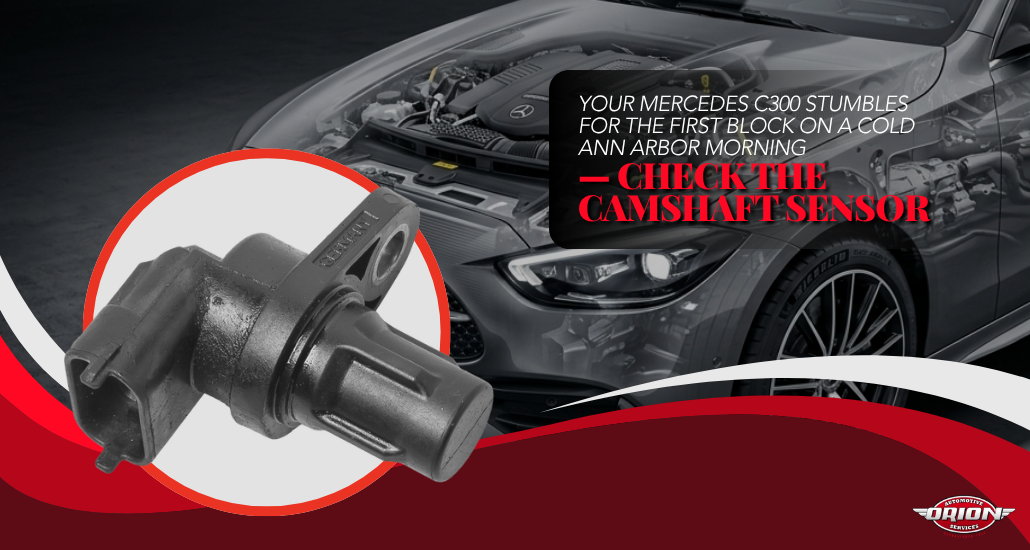
Your Mercedes C300 Stumbles for the First Block on a Cold Ann Arbor Morning — Check the Camshaft Sensor
It cranks a beat longer than it used to. Then a rough half-block down your street, a brief shudder at the first stop sign, and by the time you reach Stadium Boulevard it drives like nothing happened.
On a C300 that pattern points at the camshaft position sensors or the adjuster magnets, and Ann Arbor‘s cold mornings are what drag it into the open. It will keep doing this for weeks. Then one morning it stores a hard fault, drops into limp mode, and you are calling for a ride.
Quick Summary: Key Takeaways
- Cold-start roughness is the early sign: A stumble that clears as the engine warms is a timing-signal problem, not bad fuel.
- Two parts, one code: The sensor reports where the cam is. The adjuster magnet moves it. Both set correlation faults.
- Oil condition matters: The valve timing solenoids run on oil pressure, so sludge causes the same symptoms.
- Limp mode is the endpoint: An intermittent signal becomes a stored fault, then reduced power and a hard rev limit.
- Short trips are the worst case: Cold city driving cuts economy by as much as 24 percent on three-mile runs.
What the Camshaft Position Sensor Tells the Engine Computer
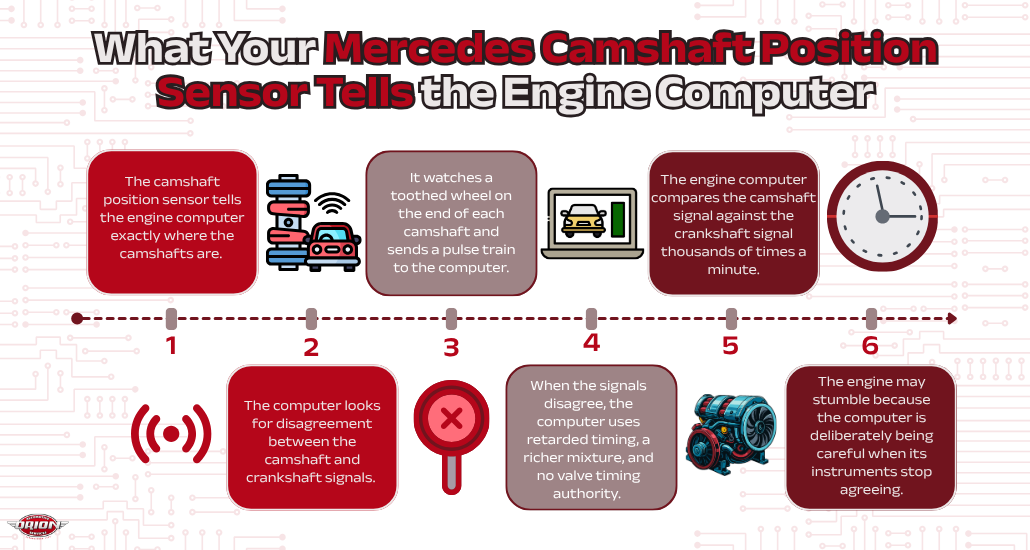
Fuel and spark timing depend on knowing exactly where the camshafts are. The position sensor watches a toothed wheel on the end of each cam and sends back a pulse train that the engine computer lines up against the crankshaft signal, thousands of times a minute, looking for disagreement.
When those two disagree, the computer has a problem. It can no longer be sure which cylinder is on which stroke, so it defaults to something safe — retarded timing, richer mixture, no valve timing authority.
That is the stumble you feel. The engine is not broken; it is being deliberately careful because its own instruments stopped agreeing with each other.
Adjuster Magnets Fail Differently Than Sensors Do
The C300’s variable valve timing uses electrically operated solenoids, often called adjuster magnets, that direct oil pressure to rotate the camshaft phasers. They sit at the front of the cylinder head, exposed to oil, heat and 100,000-plus miles of cycling.
A worn magnet cannot hold a commanded position. The computer asks for twenty degrees of advance, watches the sensor report something else, and logs a correlation fault. On a code reader that looks exactly like a bad sensor.
Telling them apart takes live data. Not a code. We command a specific cam position, watch whether the actual value follows, and that puts the blame on one part or the other inside ten minutes.
Cold Oil Is Why the Symptom Shows Up First Thing
Thick oil is slow oil. At 30 degrees the oil inside the phasers takes longer to build pressure, so a marginal solenoid or a partly clogged passage cannot move the camshaft as fast as the computer expects. Warm it up and the problem hides.
That is why the fault feels seasonal, and why a July test drive at a used car lot revealed nothing at all.
Oil service history is genuinely diagnostic here. A C300 stretched to 15,000-mile oil changes builds varnish in exactly the small passages this system depends on, and no sensor replacement fixes that.
What Ignoring the Stumble Turns Into
First the light stays on. Then the transmission shifts oddly, because it reads engine load and timing off the same network, and eventually the computer decides it has seen enough and limits power.
Limp mode is the polite version. The unlucky version is a chain-drive phaser that has been fighting oil starvation long enough to wear its bore, and once that happens the repair stops being a morning at the shop and becomes several days with the front of the engine apart.
Short-trip driving accelerates all of it. Federal cold-weather testing shows fuel economy dropping as much as 24 percent on three- to four-mile trips, which is a fair description of most Ann Arbor errands between now and spring.

How the Diagnosis Runs at Our Parkland Plaza Shop
We start cold. If the complaint happens on the first start of the day, the car sits here overnight so we can watch it happen instead of guessing.
Then it is data. Stored codes with freeze-frame conditions, commanded-versus-actual cam values, oil pressure, connectors checked for oil intrusion, and a scope trace if the numbers stay ambiguous. No parts yet.
Only then do parts get quoted. A sensor is a modest job; a set of adjuster magnets is more; a phaser is a different conversation entirely, and you deserve to know which one you are in before anyone starts.
Ann Arbor C300 Owners Have Model-Specific Help Nearby
We keep model-level coverage for the C300, the CLA 250, the E350 and the rest of the Mercedes range, plus BMW down to the 330i and X3. That is why a cam timing complaint here starts with the right questions.
Our shop is at 101 Parkland Plaza, off Jackson Road on the west side, and drivers come to us from Chelsea, Dexter, Saline and Brighton.
Cold mornings are already here. Get it looked at while the symptom is still a stumble.
Frequently Asked Questions
Q: What are the symptoms of a bad camshaft position sensor on a Mercedes C300?
A: Longer cranking, a rough idle for the first minute, hesitation under light throttle, a camshaft position or correlation code, and eventually reduced power. Symptoms are worst on a cold start and fade as the engine warms.
Q: Is it the camshaft sensor or the adjuster magnet?
A: A code reader cannot tell you. The sensor reports camshaft position and the adjuster magnet moves it, and both produce correlation faults. Watching commanded versus actual camshaft position on live data while the solenoid is commanded separates them quickly.
Q: Can a camshaft position sensor cause a no-start?
A: Yes. Many engines will still start on the crankshaft signal alone, but a fully failed sensor or a damaged signal wire can leave the computer without enough information to fire injectors, which produces a crank-but-no-start.
Q: Does oil change interval affect variable valve timing problems?
A: Significantly. The phasers and solenoids are hydraulic and depend on clean oil in small passages. Extended intervals leave varnish that restricts flow, which produces slow cam response and correlation faults that look electrical.
Get the Cold-Start Stumble Diagnosed Before It Becomes Limp Mode
Drop the car off the night before and we will see the fault the way you see it. You will get a straight answer on which part is at fault and what it takes to put it right.
Orion Automotive Service — 101 Parkland Plaza, Ann Arbor, MI 48103
Hours: Mon-Fri 8:00 AM-5:30 PM; Sat-Sun closed
Website: oriona2.com
