
Mercedes C300 Oil Leaks: What Ann Arbor Owners See
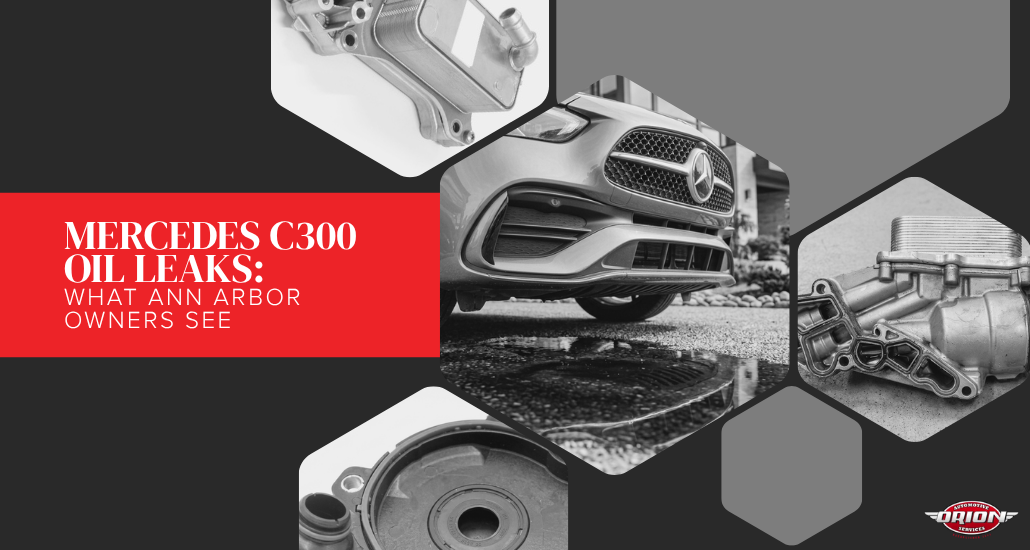
Dark spot on the garage floor. Sweet, hot smell after the drive up Jackson Road. Then the dash asks you to add a quart, six weeks after a fresh oil service, and that message is the C300 telling you a seal has given up somewhere warm and hard to reach.
Leaks on the W204 and W205 C300 rarely start big. They seep, cook onto the exhaust, and hide behind plastic covers until the belt or the alternator gets soaked.
Quick Summary: Key Takeaways
- Top suspect: the oil filter housing gasket, which drips down the front of the block and onto the belt on M276 and M274 engines.
- Second suspect: oil cooler seals sitting in the V of the 3.5 liter M276, a job that means intake removal and several hours of labor.
- Pressure matters: a torn crankcase vent diaphragm builds case pressure and pushes oil past seals that were fine last year.
- No dipstick, no warning: many C300s report level electronically, so a slow leak stays invisible until the message appears.
- Use the right oil: MB 229.5 or 229.51 approved oil at the 10,000 mile service, not whatever is on sale.
The oil filter housing gasket leads the list on C300 engines
Most C300 leaks we chase start at the oil filter housing. The gasket between the housing and the block hardens, oil weeps out under pressure, and gravity carries it straight down the front of the engine toward the accessory belt and the alternator below.
You smell it first. Oil hits the exhaust manifold, burns off, and leaves that sweet scorched odor at a red light on Stadium Boulevard, and left alone, a soaked belt can shred and take out the water pump drive with it, turning a gasket job into a tow.

Oil cooler seals and valve covers cover the rest of the top end
Mercedes hid the oil cooler on the 3.5 liter M276 down in the valley between the cylinder banks, so when those seals shrink, oil pools under the intake and runs down the back of the block, which fools people into blaming the rear main seal.
That job takes real hours. The intake manifold comes off, the cooler comes out, and every seal in the area gets replaced at once because nobody wants to go back in there twice. Valve cover gaskets weep as well, though on the C300 they usually come second to the housing and the cooler.
Crankcase pressure turns a small seal into a leak
A leak often has an upstream cause. The crankcase ventilation diaphragm, molded into the valve cover on the M274 turbo four, tears with age and lets pressure build inside the engine instead of routing it back to the intake.
Then everything sweats. Cam seals, the oil pan seam, the turbo feed line, even the dipstick tube on cars that still have one. Replacing a rear main seal on a car with a torn vent diaphragm wastes your money, because the new seal faces the same pressure that pushed out the old one.
Low oil on a C300 does real damage in a Michigan winter
Timing chains and cam adjusters need pressure. Run a quart low with cold 0W-40 in January and the tensioner and the adjusters get oil late on start-up, which is exactly where the rattle and the stretched chain begin.
There’s an outdoor cost too, since the EPA notes that used oil from one oil change can contaminate one million gallons of fresh water. Your driveway drip reaches the storm drain, then the Huron River. Fix the drip. Save the mess.
We find the source with dye and a lift, not a guess
Finding a leak takes light. We clean the engine, add UV dye, run the car up to temperature, then put it back on the lift and trace the glow to its highest point rather than the lowest puddle. Oil travels far before it drips.
Guesswork gets expensive. Shops that replace the cheapest gasket first and hope will hand you a second bill within a month. We check crankcase pressure and belt condition at the same visit, then give you the whole picture before any parts get ordered. One bill, not two.
Ann Arbor owners have been bringing Mercedes here since 1994
We’re at Parkland Plaza on the west side, an easy hop off Interstate 94, and we’ve worked on European cars in this town since 1994. Same techs. Same phones answered by people who look at the car.
Drivers come from Chelsea, Dexter and Saline because a dealership alternative that keeps a C300 leak-free for the next 80,000 miles is worth the drive, and because we tell you which repair can wait until spring and which one cannot.
Frequently Asked Questions
Q: Why is my Mercedes C300 leaking oil?
A: On most C300s the oil filter housing gasket goes first, followed by oil cooler seals on the 3.5 liter V6 and valve cover gaskets, and a torn crankcase vent diaphragm can cause several of those leaks at once by raising pressure inside the engine.
Q: How much oil can a C300 lose before it hurts the engine?
A: Don’t find out. Once the level drops about a quart, the timing chain tensioner and cam adjusters see delayed pressure on cold start-up, which is how chains stretch and adjusters rattle.
Q: Can you drive a Mercedes with an oil leak?
A: Short trips, maybe. Oil on the accessory belt or the exhaust changes the answer immediately, because a shredded belt strands the car and oil on a hot manifold is a fire risk.
Q: What oil does a Mercedes C300 take?
A: One that carries Mercedes approval 229.5 or 229.51, depending on the engine and model year. Service comes around every 10,000 miles or once a year, and the approval printed on the bottle matters more than the brand does.
Bring the leak in before it reaches the belt
Book a visit and we’ll clean, dye and trace the leak instead of guessing at gaskets. Weekday mornings fill up first, so grab a slot online.
Orion Automotive Service — 101 Parkland Plaza, Ann Arbor, MI 48103
Hours: Mon-Fri 8:00 AM-5:30 PM; Sat-Sun closed
Website: oriona2.com
